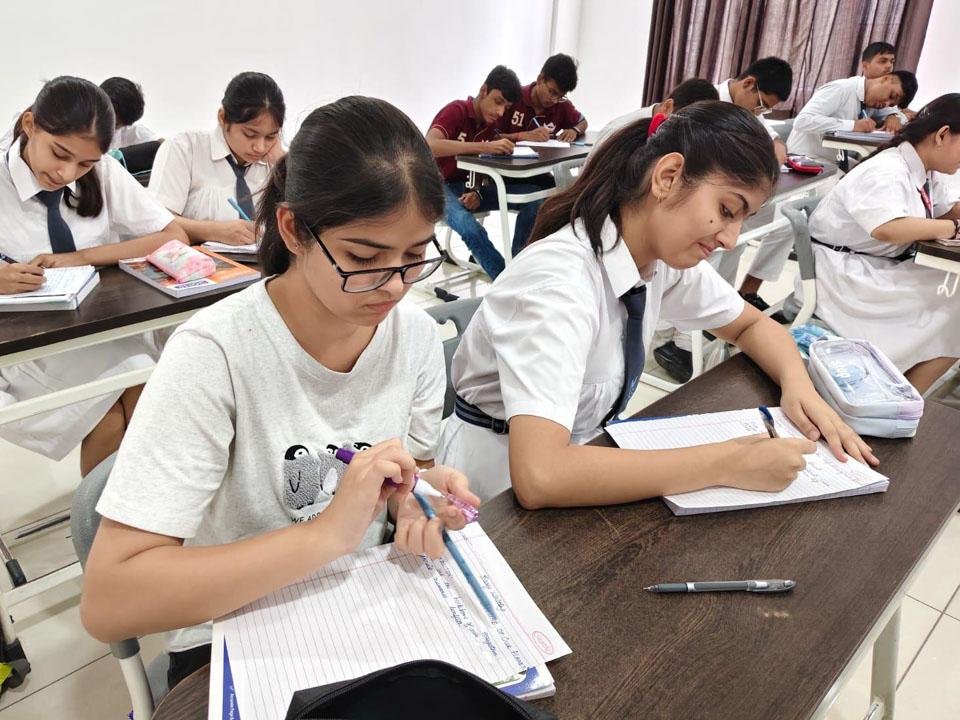
Four government-school students in Amritsar have developed a Wi-Fi-controlled robot car and a facial-recognition attendance system. Their projects show how classroom learning can turn into practical innovation.
From Classroom to Innovation: How School Students Are Building Robots and Smart Technology
Technology is no longer limited to engineering colleges, research laboratories or big companies. School students are also learning to build practical projects using robotics, coding and electronic components. With the right guidance and curiosity, even a classroom can become a place for innovation.
A recent example comes from Amritsar, Punjab, where four students from a government school have developed two interesting technology projects: a Wi-Fi-controlled robotic car and a facial-recognition attendance system.
Their work is a reminder that students do not always need expensive laboratories to explore technology. Sometimes, a good idea, basic resources and support from teachers are enough to get started.
Four Students Turn Their Ideas into Working Projects
Students from Government Senior Secondary School, Bhangali, in Amritsar have developed two technology models using resources available to them.
The students are preparing to present their projects at a district-level Digital Innovation Tech Fair scheduled for 18 November 2026.
The two projects focus on different areas of technology: robotics and automated attendance.
- A Robot Car Controlled Through Wi-Fi
Two students, Harmandeep Singh and Manjot Preet Singh, worked together to develop a robotic car that can be controlled using a mobile phone.
The model uses an ESP32 development board, four DC motors, a motor driver and a battery pack. It creates a Wi-Fi network that allows a mobile phone to connect with the car.
Through controls on an app or webpage, the user can move the vehicle forward, backward, left or right.
According to the report, the model can operate from approximately 30 to 50 metres away.
The project also offers opportunities for further development. A camera or obstacle-detection sensors could be added in the future to expand its capabilities.
- A Facial-Recognition Attendance System
The second project was developed by Gurnaz Kaur and Kushpreet Singh.
Their system uses a camera to recognise students' faces and record attendance digitally. When a student appears in front of the camera, the system identifies the face and displays the student's name.
The attendance information is then recorded in an Excel sheet with the date and time.
Such a system could help teachers organise attendance records and reduce some manual work. However, facial-recognition technology must be tested carefully to ensure accuracy, reliability and protection of students' personal information.
Why Are These Projects Important for School Education?
These projects are interesting not simply because they use modern technology, but because students have tried to apply what they learn to practical situations.
Traditional classroom learning often focuses on understanding concepts through textbooks and examinations. Practical projects allow students to explore how those concepts work in real life.
For example, building a robot can introduce students to motors, circuits, programming and problem-solving. Developing an attendance system can help them understand cameras, software, data storage and automation.
This approach makes learning more interactive and encourages students to ask questions rather than simply memorising information.
What Can Students Learn from Robotics Projects?
Robotics combines several subjects and skills. Students who explore this field can gradually develop knowledge in different areas.
Basic electronics: Students learn how batteries, wires, sensors and motors work together.
Programming: They understand how instructions can control the movement and behaviour of a machine.
Problem-solving: A robot may not work correctly on the first attempt. Students learn to identify errors and improve their design.
Teamwork: Most practical projects require students to share responsibilities and work towards a common goal.
Creative thinking: Students learn to turn an everyday problem into an idea for a useful solution.
These skills can be useful in many future career paths, including engineering, software development, automation and product design.
How Can Beginners Start Learning Robotics?
Students do not need to build a complicated robot as their first project. Starting with small activities can make the learning process easier.
Here are some beginner-friendly ideas:
Simple LED circuit: Learn how electricity flows through a basic circuit and how an LED lights up.
Mini fan project: Use a small motor and battery to understand how electrical energy creates movement.
Obstacle-detection model: Explore how sensors can identify objects in front of a small vehicle.
Mobile-controlled car: Learn how a phone can send instructions to a robotic model.
Smart plant watering system: Build a simple model that uses a moisture sensor to identify when a plant needs water.
Students should work with suitable supervision, especially when handling batteries, electrical connections and tools.
The Role of Teachers in Student Innovation
Teachers play an important role in helping students move from ideas to practical projects.
They can encourage learners to identify everyday problems and think about how technology might help solve them. Instead of immediately providing the answer, teachers can guide students through research, planning, testing and improvement.
Schools can also organise small innovation clubs, science exhibitions and project-based learning sessions.
Not every student will become an engineer, but every student can benefit from learning how to think logically, experiment and solve problems.
How Parents Can Encourage Children to Explore Technology
Parents do not need to be technology experts to support a child's interest in innovation.
They can begin with simple steps:
Encourage children to ask questions about how everyday devices work.
Provide age-appropriate books, learning kits and educational resources.
Allow children to experiment with simple supervised projects.
Appreciate effort and improvement rather than expecting perfect results.
Encourage participation in school exhibitions and science activities.
Help children balance screen time with practical learning.
The most important thing is to give children the confidence to try something new.
Technology Learning Is About More Than Expensive Equipment
Many students believe that innovation requires advanced laboratories and costly machines. While specialised equipment can be useful, it is not the only way to begin.
Basic electronics, free programming resources, recycled materials and school science equipment can help students understand many important concepts.
The key is to begin with a problem, learn the basics and improve the project step by step.
Schools can also create opportunities for students to share their ideas and learn from one another.
Frequently Asked Questions (FAQs)
- What is robotics in school education?
Robotics in school education introduces students to building and controlling machines using motors, sensors, electronic components and programming.
- Can school students learn robotics without prior experience?
Yes. Students can start with basic circuits, simple motors and beginner-friendly programming activities before moving on to more advanced projects.
- What is an ESP32 board?
An ESP32 is a microcontroller development board with built-in wireless connectivity. It is commonly used in electronics, automation and robotics projects.
- What is a facial-recognition attendance system?
It is a system that uses facial-recognition software to identify individuals and record their attendance digitally. Such systems require careful attention to accuracy and privacy.
- How can schools promote innovation?
Schools can organise science exhibitions, robotics clubs, practical workshops, group projects and technology demonstrations.
- Are robotics projects useful for future careers?
Robotics projects can introduce students to skills related to engineering, programming, automation, electronics and problem-solving.
Final Thoughts
The projects developed by students in Amritsar show how curiosity and practical learning can lead to interesting ideas. A robotic car and a digital attendance system may look like small achievements, but the process behind them involves research, teamwork, experimentation and problem-solving.
Schools should give students more opportunities to explore technology beyond textbooks. With proper guidance and access to learning resources, young learners can develop skills that prepare them for a technology-driven future.
Innovation does not always begin with a big invention. Sometimes, it starts with a simple question: Can I build something that solves this problem?
 Study Tips
 Study Tips
 Study Tips