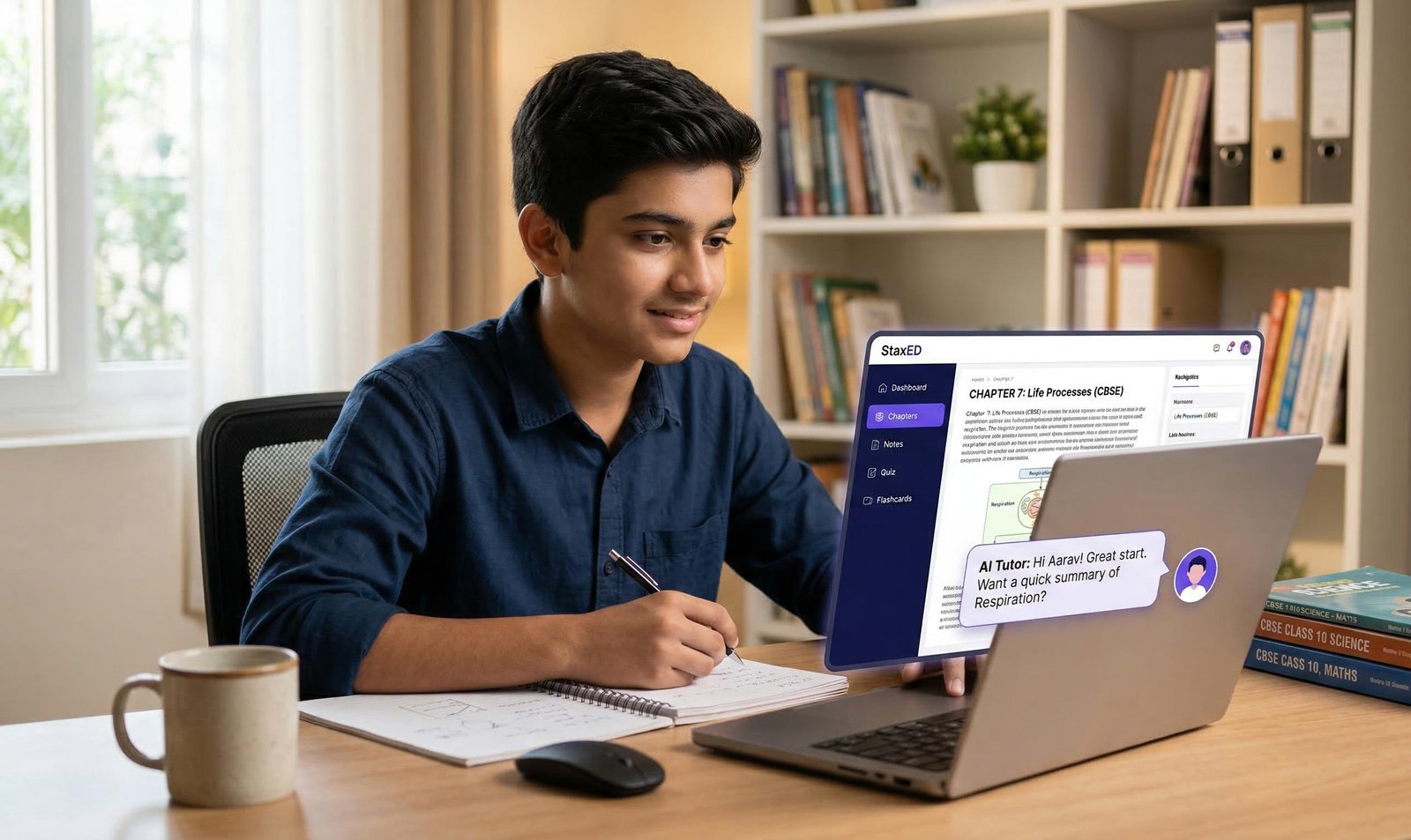
Discover how students can use Artificial Intelligence for homework, revision, concept learning and exam preparation while developing independent thinking skills.
How Students Can Use AI for Studying: Benefits, Risks and Smart Learning Tips
Artificial Intelligence is slowly changing the way students learn. Today, a student can ask an AI tool to explain a difficult chapter, create practice questions, summarise a topic or help understand a complicated concept.
Earlier, students often had to search through multiple books and websites to find an explanation. Now, AI tools can provide quick responses and help learners explore different ways of understanding a subject.
However, using AI for education does not mean students should stop thinking independently. The real benefit comes when technology supports learning instead of replacing it.
Let's understand how students can use AI effectively in their daily studies.
Why Is AI Becoming Important in Education?
AI is becoming an important part of modern education because it can make learning more flexible and interactive.
Students learn at different speeds. Some understand a topic quickly, while others need more examples and explanations. AI tools can help students explore subjects at their own pace.
In India, the Ministry of Education has highlighted the importance of Artificial Intelligence and Computational Thinking in school education. A dedicated curriculum for Classes 3 to 8 is being implemented from the 2026–27 academic session.
This shows why understanding AI is becoming an important skill for future learners.
7 Smart Ways Students Can Use AI for Studying
- Understand Difficult Topics
Sometimes, textbook explanations are difficult to understand. Students can ask AI to explain the same topic in simpler language.
For example, a student struggling with photosynthesis can ask for a step-by-step explanation with everyday examples.
This can make complicated concepts easier to understand.
- Create Practice Questions
Practising questions regularly helps students check their understanding.
Students can ask AI to prepare multiple-choice questions, short-answer questions and topic-based quizzes.
For better results, students should first attempt the questions themselves and then check the answers.
- Improve English and Writing Skills
Students who want to improve their English can use AI to understand grammar rules, correct sentence structure and learn new vocabulary.
They can also practise writing paragraphs and receive suggestions for improvement.
However, students should write their own answers rather than submitting AI-generated work without understanding it.
- Prepare a Study Timetable
Managing different subjects can become difficult, especially during examinations.
AI can help students create a study timetable based on their available time, subjects and upcoming tests.
A realistic timetable should include revision, practice sessions, short breaks and sufficient sleep.
- Revise Important Concepts
Students can use AI to prepare short revision notes, flashcards and quick quizzes.
For example, after completing a chapter in Biology, a student can ask for ten important questions to test their understanding.
This makes revision more interactive.
- Learn at Your Own Pace
One useful feature of AI is that students can ask follow-up questions whenever they do not understand something.
They can request another explanation, a practical example or a simpler version of the same concept.
This can help learners become more comfortable asking questions.
- Explore New Skills
Apart from school subjects, students can use AI to explore coding, communication, creative writing, research and other skills.
Learning these skills can help students understand different career opportunities and prepare for future challenges.
Benefits of Using AI in Education
When used responsibly, AI can offer several learning benefits.
Quick explanations: Students can explore difficult topics without spending too much time searching for basic explanations.
Flexible learning: Learners can study at their own pace.
More practice: AI can generate additional questions and exercises.
Language support: Students can explore explanations in simpler language.
Better revision: Short notes and quizzes can support regular revision.
Learning confidence: Students may feel more comfortable asking questions they hesitate to ask in a classroom.
AI can support teachers and students, but it cannot replace the value of good teaching, classroom discussions and personal effort.
Risks of Depending Too Much on AI
Although AI offers many benefits, students should also understand its limitations.
- Less Independent Thinking
If students ask AI to solve every question, they may miss the opportunity to develop their own problem-solving skills.
- Incorrect Information
AI tools can sometimes provide incorrect, incomplete or outdated information. Students should verify important facts using textbooks, teachers and reliable sources.
- Copying Homework
Copying complete assignments from AI may save time, but it does not necessarily improve understanding.
Students should use AI for guidance and complete their work in their own words.
- Privacy Concerns
Students should avoid sharing personal information, passwords, school records, phone numbers or private documents with AI tools.
They should also follow the age requirements and safety guidelines of the platforms they use.
- Reduced Focus
Constantly switching between study material, AI tools and social media can interrupt concentration.
Students should use technology with a clear purpose and avoid unnecessary screen time.
Useful AI Prompts Students Can Try
Students often get better results when they ask clear and specific questions.
Here are a few examples:
For understanding a topic:
"Explain the water cycle in simple language with an example suitable for a Class 7 student."
For Mathematics practice:
"Give me five questions on linear equations, starting from easy to difficult. Do not show the answers until I attempt them."
For Science revision:
"Prepare ten important revision questions from the chapter on electricity. Include a mix of MCQs and short-answer questions."
For English improvement:
"Check my paragraph for grammar mistakes and explain why each correction is needed."
For exam preparation:
"Create a seven-day revision timetable for my upcoming Science examination. Include daily revision and practice time."
Students should always review the answers and make sure they understand the information.
What Should Parents and Teachers Do?
Parents and teachers have an important role in helping students use AI responsibly.
They should encourage children to ask questions, explore concepts and practise independently.
Some useful steps include:
Discuss the benefits and limitations of AI with students.
Encourage students to verify information.
Teach children not to share private information online.
Set reasonable screen-time boundaries.
Encourage reading books and solving questions without AI assistance.
Make students explain what they have learned in their own words.
The aim should be to help students become confident learners who know how to use technology wisely.
Can AI Replace Teachers?
No. AI can provide explanations, practice questions and learning support, but teachers offer much more than information.
Teachers understand classroom behaviour, student emotions, learning difficulties and individual progress. They can guide students, encourage participation and provide personal feedback.
AI should be treated as an additional learning resource, not a replacement for teachers.
Frequently Asked Questions (FAQs)
- How can students use AI for studying?
Students can use AI to understand difficult topics, practise questions, prepare revision notes, improve writing skills and organise study schedules.
- Is AI helpful for school students?
Yes, AI can support school students when used appropriately. It can make learning interactive and provide additional explanations and practice.
- Can AI solve Maths and Science questions?
AI tools can help explain and solve many Maths and Science questions. However, students should verify the solutions and understand the steps instead of copying the final answers.
- Is it good to use AI for homework?
AI can be used to understand homework questions and get guidance. Students should complete assignments honestly and follow their school's rules regarding AI use.
- Can AI replace traditional books?
No. Textbooks remain important for structured learning and syllabus-based preparation. AI should be used alongside books and guidance from teachers.
- What is the biggest risk of using AI in education?
One major risk is becoming dependent on AI for every task. Students may lose opportunities to develop independent thinking, creativity and problem-solving skills.
Final Words
Artificial Intelligence can make studying easier, but it cannot do the learning on behalf of students.
The best approach is to use AI for explanations, practice and guidance while continuing to read textbooks, solve questions and think independently.
Students who learn how to use technology responsibly can develop useful skills for the future. Remember, AI can provide assistance, but real understanding comes from curiosity, practice and consistent effort.
 Online Learning
 Online Learning
 Online Learning