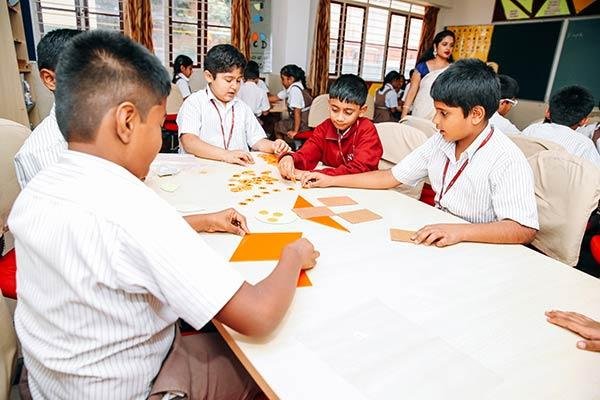
CBSE has announced the Aryabhata Ganit Challenge 2026 for Classes 8 to 10. Check eligibility, registration deadlines, exam pattern, stages and preparation tips.
Eligibility
Mathematics is not just about solving equations, remembering formulas or scoring marks in examinations. It is also about understanding numbers, recognising patterns and using logical thinking to solve everyday problems.
To encourage these skills, the Central Board of Secondary Education (CBSE) has announced the Aryabhata Ganit Challenge 2026 for students of Classes 8 to 10.
The competition gives students an opportunity to test their mathematical understanding through real-life situations and problem-solving activities.
If you are a student, parent or teacher, here is everything you should know about the challenge, including eligibility, important dates and preparation tips.
What Is the CBSE Aryabhata Ganit Challenge 2026?
The Aryabhata Ganit Challenge is a mathematics competition organised by CBSE to encourage students to apply mathematical concepts in practical situations.
The objective is to develop logical reasoning, analytical thinking and problem-solving abilities among school students.
The 2026 edition will be organised in two stages:
Stage 1: School-level competition.
Stage 2: National-level computer-based test.
Students from Classes 8, 9 and 10 studying in CBSE-affiliated schools are eligible for the first stage.
CBSE Aryabhata Ganit Challenge 2026: Important Dates
Students and schools should keep the following dates in mind.
4 November 2026: Registration for Stage 1 begins.
18 November 2026: Last date for schools to register for Stage 1.
25–26 November 2026: Stage 1 question paper and answer keys will be available to schools.
27–30 November 2026: Registration period for Stage 2.
2 December 2026: National-level computer-based test.
An important point is that registration is handled through schools. Students should contact their mathematics teacher or school administration instead of assuming they can register individually.
Who Can Participate in the Aryabhata Ganit Challenge?
The competition is open to students of:
Class 8
Class 9
Class 10
However, only students studying in CBSE-affiliated schools can participate.
All eligible students can take part in the first stage through their schools. After the school-level assessment, each participating school will select its top three students for the national-level stage.
Understanding the Two Stages of the Competition
Stage 1: School-Level Competition
The first stage will be conducted by individual schools on their campuses.
CBSE will make the question paper and answer key available through its official portal during the specified dates. Schools will download the material and organise the assessment.
There is no participation fee for Stage 1.
After evaluating the performance, each school will select its three best-performing students for the next stage.
Stage 2: National-Level Competition
The second stage will be conducted by CBSE as an online computer-based test.
Only the top three students selected by each participating school can move forward.
Schools must complete the Stage 2 registration within the prescribed period and pay the applicable fee of ₹900 per school. The fee is non-refundable.
The national-level test is scheduled for 2 December 2026.
What Is the Exam Pattern?
Both stages are designed to assess students' understanding and application of mathematics.
The assessment details include:
Duration: 1 hour
Total marks: 40
Question type: Multiple-choice questions
Negative marking: No
The challenge focuses on mathematical understanding and practical application rather than only memorising textbook formulas.
Important Topics for the Aryabhata Ganit Challenge
Students should prepare the following areas:
- Number Sense and Number Systems
This area covers numerical understanding, calculations, number patterns and the application of number concepts.
- Geometry and Spatial Sense
Students should understand shapes, angles, measurements, spatial relationships and geometric reasoning.
- Algebra
Basic algebraic concepts, expressions, equations and logical applications are important areas of preparation.
- Quantitative Aptitude
This involves interpreting numerical information, comparing quantities and solving practical mathematical problems.
- Data Analysis and Probability
Students may need to understand charts, tables, numerical information, patterns and basic probability concepts.
- Mensuration
This area includes measurements related to shapes, including perimeter, area and volume.
Students should refer to the official CBSE circular for the complete assessment areas and instructions.
How Can Students Prepare for the Aryabhata Ganit Challenge?
Students do not need to study mathematics in a completely different way for this competition. They should focus on understanding concepts and applying them correctly.
Here are some useful preparation tips.
Practise Application-Based Questions
Try solving questions connected to daily activities, such as calculating discounts, measuring distances, comparing prices and understanding expenses.
Improve Mental Calculation
Practise basic calculations regularly. Better numerical fluency can help students solve questions more confidently.
Understand Concepts Instead of Memorising Formulas
Learn why a formula works and where it can be used. Understanding concepts makes it easier to solve unfamiliar questions.
Solve Logical Reasoning Problems
Puzzles, number patterns and reasoning exercises can help develop analytical thinking.
Manage Time During Practice
Since the challenge has a one-hour duration, students should practise answering questions within a limited time.
Revise Mathematics Regularly
Spend some time every day revising important concepts from the school syllabus. Consistent practice is more useful than last-minute preparation.
Why Should Students Participate?
The Aryabhata Ganit Challenge offers more than an opportunity to take part in a competition.
It can help students:
Develop logical and analytical thinking.
Improve mathematical problem-solving skills.
Apply classroom concepts to real-life situations.
Build confidence in mathematics.
Experience a national-level academic competition.
Identify areas where they need further practice.
CBSE also provides recognition through certificates for high-performing students and participating schools, according to the competition guidelines.
How Can Schools Register?
Registration is managed by the participating CBSE-affiliated schools through the designated CBSE portal.
Students should speak to their school principal, mathematics teacher or academic coordinator to confirm participation.
Schools should:
Read the official CBSE circular carefully.
Complete Stage 1 registration before 18 November 2026.
Conduct the school-level assessment during the prescribed window.
Select the top three students.
Complete Stage 2 registration between 27 and 30 November.
Follow the instructions for the national-level test.
Schools should use the official CBSE portal for registration and updated instructions.
Frequently Asked Questions
- What is the last date for Aryabhata Ganit Challenge 2026 registration?
The last date for schools to register for Stage 1 is 18 November 2026.
- Which classes are eligible for the competition?
Students studying in Classes 8, 9 and 10 in CBSE-affiliated schools can participate in Stage 1.
- Is there any registration fee?
Stage 1 is free. Stage 2 has a fee of ₹900 per school, which is non-refundable.
- When will the national-level examination take place?
The Stage 2 computer-based test is scheduled for 2 December 2026.
- Can students register individually?
The registration process is handled through CBSE-affiliated schools. Students should contact their school administration for participation.
- What is the duration of the challenge?
Both stages have a duration of one hour and carry 40 marks, with multiple-choice questions and no negative marking.
Final Thoughts
The CBSE Aryabhata Ganit Challenge 2026 is a valuable opportunity for students to explore mathematics beyond regular classroom exercises.
It encourages learners to think logically, understand numerical concepts and use mathematics in practical situations.
Students interested in participating should speak with their schools as soon as possible because the Stage 1 registration deadline is 18 November 2026.
At GharmeShiksha.com, we believe that competitions like these help students develop confidence, curiosity and a stronger understanding of the subjects they learn every day.
 Board Updates
 Board Updates
 Board Updates