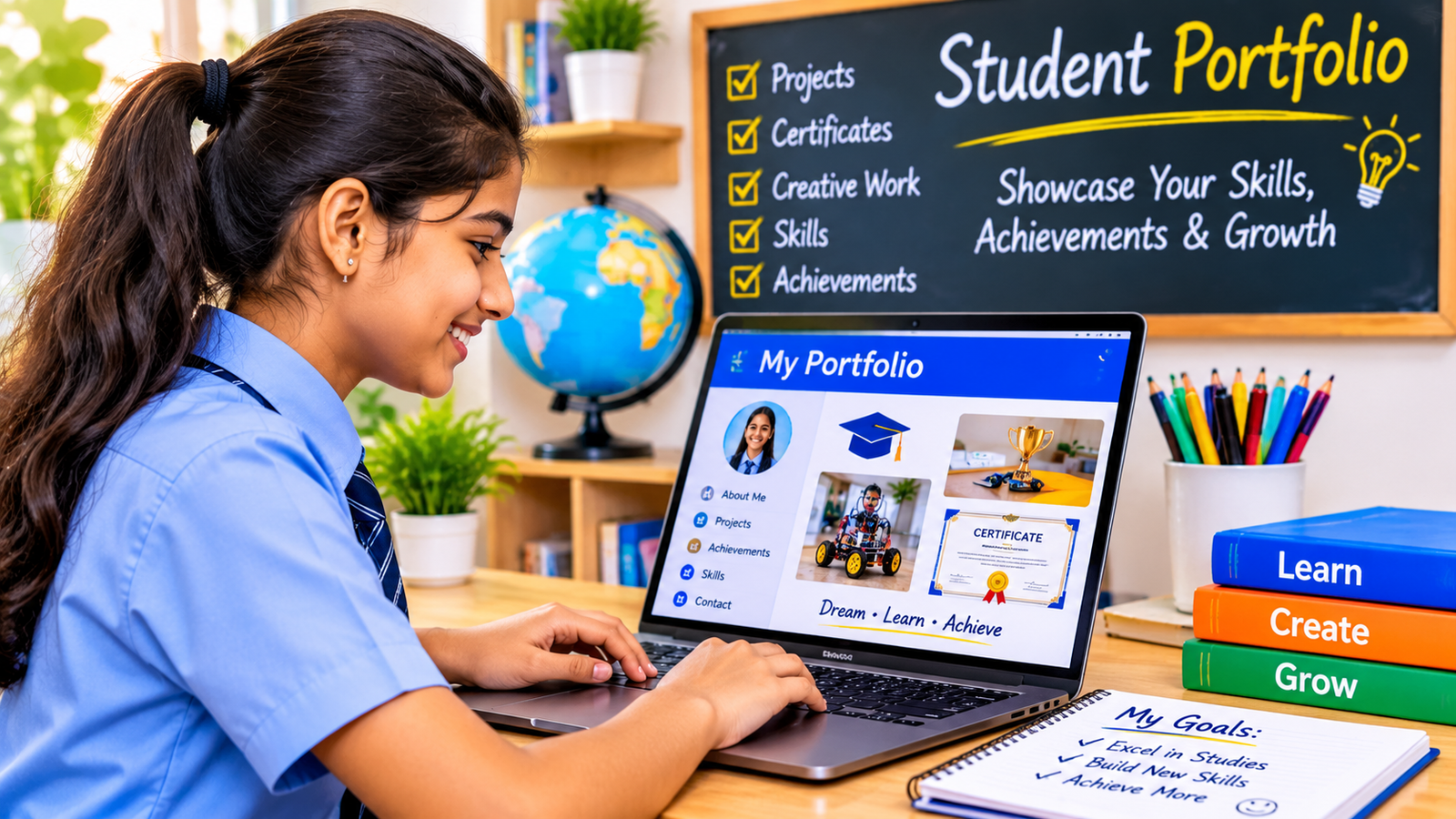
Academic marks are important, but they do not always show a student's creativity, practical abilities, achievements and personal growth. Learn how students can build a strong portfolio to showcase projects, skills, certificates and experiences.
# How to Build a Student Portfolio in 2026: Why Marksheets Are No Longer the Whole Story
Imagine two students applying for the same college course. Both have similar examination marks, but one can also present a collection of completed projects, creative work, certificates, research activities and practical achievements.
Which student can give a clearer picture of their abilities beyond examination results?
This is where a student portfolio becomes valuable.
For years, academic marksheets and examination results have played a major role in measuring student performance. However, they cannot always capture creativity, communication, leadership, problem-solving or the ability to apply classroom knowledge in real situations.
As education increasingly focuses on competency-based learning, practical projects and skill development, maintaining a student portfolio can help learners document their progress and present their work meaningfully.
Whether a student is in middle school, secondary school, higher secondary education or college, starting a portfolio can be a useful step towards personal and academic development.
1. What Is a Student Portfolio?
A student portfolio is an organised collection of a learner's academic work, achievements, projects, skills and experiences.
It acts as a record of what a student has learned and created over time.
Unlike a marksheet, which mainly presents examination performance, a portfolio can show the process behind learning.
For example, it may include:
- School and college projects
- Certificates from competitions
- Creative writing and artwork
- Science experiments and models
- Coding and technology projects
- Research assignments
- Sports and extracurricular achievements
- Volunteering experiences
- Reflections on personal learning
A portfolio does not need to be complicated or expensive. A simple folder, presentation or organised digital document can be a good starting point.
2. Why Are Student Portfolios Becoming More Important in 2026?
Education is gradually moving beyond the idea that learning should only be measured through written examinations.
The National Education Policy 2020 encourages holistic assessment, project-based learning, inquiry-based activities, self-assessment and student portfolios as part of understanding a learner's progress.
The Ministry of Education has also highlighted the expansion of skill-based and experiential learning in schools, including pre-vocational exposure for Classes VI to VIII and skill education for Classes IX to XII.
These developments make it useful for students to maintain evidence of what they learn and accomplish.
A well-organised portfolio can help students:
Show practical abilities: A completed project can demonstrate how a student applies classroom knowledge.
Track personal growth: Comparing older and newer work helps learners recognise their improvement.
Explore interests: Students can identify subjects and activities they genuinely enjoy.
Prepare for future opportunities: A portfolio can help students organise material for suitable college applications, internships, competitions or interviews where such evidence is requested.
Develop self-confidence: Seeing their progress can encourage students to take on new challenges.
A portfolio does not guarantee admission, scholarships or employment. Its value depends on the quality of work and the requirements of the opportunity.
3. What Should a Student Include in a Portfolio?
The best student portfolios are organised, relevant and genuine. Students should focus on meaningful work rather than collecting certificates simply to increase the number of pages.
Here are some important sections to consider.
A. Personal Introduction
Start with a short introduction that explains who the student is, their current class or course, academic interests and areas they enjoy exploring.
Students can mention their favourite subjects, hobbies and learning goals.
Avoid publishing sensitive personal information such as a home address, personal phone number or private identification details.
B. Academic Projects
Projects are among the most useful parts of a portfolio because they show how students apply what they learn.
Examples include:
- A working science model
- A mathematics investigation
- A history research assignment
- An environmental awareness project
- A geography presentation
- A language or creative writing assignment
Students should include a short explanation of the objective, their role, the process and what they learned.
C. Certificates and Achievements
Students can include relevant certificates from:
- Academic competitions
- Olympiads
- Debate competitions
- Art and cultural events
- Sports tournaments
- Coding challenges
- Workshops and educational programmes
Certificates should be authentic and accompanied by the issuing organisation and date wherever possible.
D. Creative Work
Creativity is not limited to art classes.
A portfolio can include original stories, poems, photographs, illustrations, graphic designs, videos, presentations and other creative projects.
Students interested in design, media, communication or content creation may find this section particularly useful.
E. Technical and Digital Skills
Technology-related work can help students demonstrate practical learning.
Examples include:
- Beginner coding projects
- Simple websites
- Robotics models
- Digital presentations
- Spreadsheet projects
- Educational videos
- Basic data visualisations
Students should explain which tools they used and what they personally contributed.
F. Extracurricular Activities
School life includes much more than classroom learning.
Students can document participation in sports, music, dance, theatre, public speaking, student clubs, community activities and volunteering.
These experiences may demonstrate teamwork, commitment, communication and initiative.
G. Personal Reflections
This section is often overlooked, but it can make a portfolio more meaningful.
Students can write a few sentences about:
- What they learned from a project
- Which challenge they faced
- How they improved their work
- What they would do differently next time
- Which new skill they want to develop
Reflection helps turn a collection of documents into a record of learning.
4. How to Create a Student Portfolio Step by Step
Students do not need to complete everything in one day. A portfolio can grow gradually throughout the academic year.
Step 1: Decide the Purpose
First, understand why the portfolio is being created.
Is it for personal development, a school assignment, college applications, a competition or career exploration?
The purpose determines which work should receive priority.
Step 2: Choose a Format
There are two common formats.
Physical portfolio: A folder or file containing printed certificates, photographs, written assignments and project reports.
Digital portfolio: An organised collection of documents, photographs, presentations, videos and project links stored digitally.
Students can maintain both formats if needed.
Step 3: Collect Existing Work
Start by gathering completed school assignments, project photographs, certificates and creative work.
Choose quality over quantity. A few well-explained projects are more useful than dozens of unrelated documents.
Step 4: Organise the Content
Divide the portfolio into clear sections such as academics, projects, creative work, achievements and extracurricular activities.
Use simple headings and dates so that readers can understand the work easily.
Step 5: Add Descriptions
Do not upload photographs or certificates without context.
Write a short explanation of each important project, including its purpose, the student's contribution and the main learning outcome.
Step 6: Update It Regularly
Set aside time at the end of every month or school term to add new work and remove outdated or irrelevant material.
A portfolio should represent the student's current abilities and progress.
5. Best Digital Portfolio Ideas and Tools for Students
Digital portfolios can be created using tools that students may already use for schoolwork.
Some options include:
Google Sites: Students can organise projects, presentations, photographs and written work into a simple website.
Canva: Useful for designing visual portfolios, project presentations and creative work samples.
Google Drive: Helps students organise certificates, documents, photographs and project files into folders.
Microsoft PowerPoint: A simple option for creating a presentation-based portfolio.
Adobe Express: Can help students present creative projects and visual work.
The choice of platform should depend on the student's age, digital skills, school guidelines and privacy requirements. Younger students should create and manage digital portfolios with appropriate adult supervision.
Students should also check whether a platform's sharing settings make their work public or private before uploading anything.
6. Student Portfolio Examples for Different Age Groups
A portfolio should match the student's age, interests and educational stage.
For Classes 6 to 8
Younger students can begin with simple examples of learning and creativity:
- Science models
- Book reviews
- Drawings and artwork
- Handwritten stories
- Mathematics activities
- Nature observation journals
- Classroom presentations
The objective should be to develop the habit of documenting learning, not to create a professional-looking profile.
For Classes 9 and 10
Students can start including more structured projects:
- Science investigations
- Social science research
- Debate and speech certificates
- Coding experiments
- Environmental projects
- Subject-based presentations
- Sports and extracurricular achievements
This is also a useful stage to explore different interests before choosing future academic streams.
For Classes 11 and 12
Senior secondary students can develop portfolios around their academic interests and potential career paths.
Examples include:
- Business plans and entrepreneurship projects
- Research-based assignments
- Programming and web development projects
- Design and photography work
- Writing samples
- Volunteering experiences
- Subject-specific projects
- Participation in recognised competitions
Students should check the portfolio requirements of individual colleges, universities, competitions or scholarship programmes because expectations can differ.
For College Students
College portfolios can include internships, academic research, case studies, professional projects, presentations, practical assignments and relevant certifications.
Students preparing for creative or technology-related careers may also include carefully selected work samples and links to completed projects.
7. Common Mistakes Students Should Avoid
A portfolio should present genuine abilities rather than simply look impressive.
Here are some mistakes to avoid:
Adding everything without organisation: Too many unrelated documents make it difficult to understand the student's strengths.
Copying projects from the internet: A portfolio should reflect original work and clearly acknowledge external sources.
Ignoring personal contribution: In group projects, students should explain their own role rather than claiming the entire team's work.
Using outdated information: Review the portfolio regularly and update achievements and project details.
Focusing only on certificates: A meaningful project explanation may show more about a student's learning than a certificate alone.
Ignoring privacy: Do not publicly display personal contact details, school identification information or photographs of others without appropriate permission.
Making exaggerated claims: Describe skills honestly and include actual examples wherever possible.
8. How Parents and Teachers Can Help Students Build Better Portfolios
Students may need guidance when deciding what to include and how to present their work.
Parents and teachers can support the process without taking control of it.
Parents can:
- Encourage children to preserve their best school projects.
- Help organise certificates and photographs.
- Discuss interests and future learning goals.
- Encourage original work instead of copying online examples.
- Help younger children manage digital privacy.
Teachers can:
- Suggest portfolio sections related to different subjects.
- Encourage project documentation.
- Give feedback on project descriptions.
- Help students reflect on their progress.
- Introduce digital portfolio activities in classrooms.
The objective is to make students responsible for documenting their own learning.
9. How a Student Portfolio Can Support Future Career Planning
A portfolio can help students understand what they enjoy doing and which abilities they want to improve.
For example, a student who regularly creates websites may discover an interest in technology. Someone who enjoys writing articles and participating in debates may explore communication, journalism or related fields.
A student interested in business might document a small entrepreneurship project, while someone interested in science could maintain a collection of experiments and research assignments.
This does not mean students must decide their careers early. Instead, a portfolio gives them an opportunity to explore different interests and recognise patterns in their learning.
It can also make career conversations with parents, teachers and counsellors more specific because students have actual examples of their work to discuss.
10. A Simple Monthly Portfolio Routine for Students
Building a portfolio becomes easier when it is part of a regular learning routine.
At the end of each month, students can:
- Select one or two meaningful pieces of work.
- Save photographs, documents or project links.
- Write a short description of what they did.
- Mention one skill they practised.
- Record one challenge they overcame.
- Identify something they would like to improve.
Over a school year, these small updates can create a useful record of academic progress and personal development.
Frequently Asked Questions
1. What is a student portfolio?
A student portfolio is an organised collection of academic projects, achievements, creative work, certificates, skills and learning experiences that demonstrates a student's development over time.
2. How do I create a student portfolio?
Start by deciding its purpose, selecting a physical or digital format, collecting relevant work, organising it into sections and adding short descriptions. Update it regularly.
3. Is a digital portfolio better than a physical portfolio?
Both formats are useful. A digital portfolio is easier to share and update, while a physical portfolio can be convenient for classroom presentations and school activities.
4. What should a student portfolio include?
It can include academic projects, certificates, creative work, technical skills, extracurricular achievements, research assignments and personal reflections.
5. Can school students create portfolios without professional experience?
Absolutely. School projects, science models, writing assignments, artwork, presentations and extracurricular activities are all suitable starting points.
6. Do colleges require student portfolios?
Some colleges and programmes request portfolios, particularly in creative and specialised fields. Requirements differ, so students should check the official admission guidelines of each institution.
Conclusion
Academic marks remain important, but they are only one part of a student's educational journey.
A student portfolio offers another way to document learning, creativity, practical abilities and personal development. It helps students recognise their achievements, understand their interests and present their work in an organised manner.
The best time to start is not after completing school or when applying for college. Students can begin with a simple project today and gradually build a meaningful record of their progress.
In 2026, learning matters, but being able to demonstrate what you have learned can be equally valuable.
 Study Tips
 Study Tips
 Study Tips