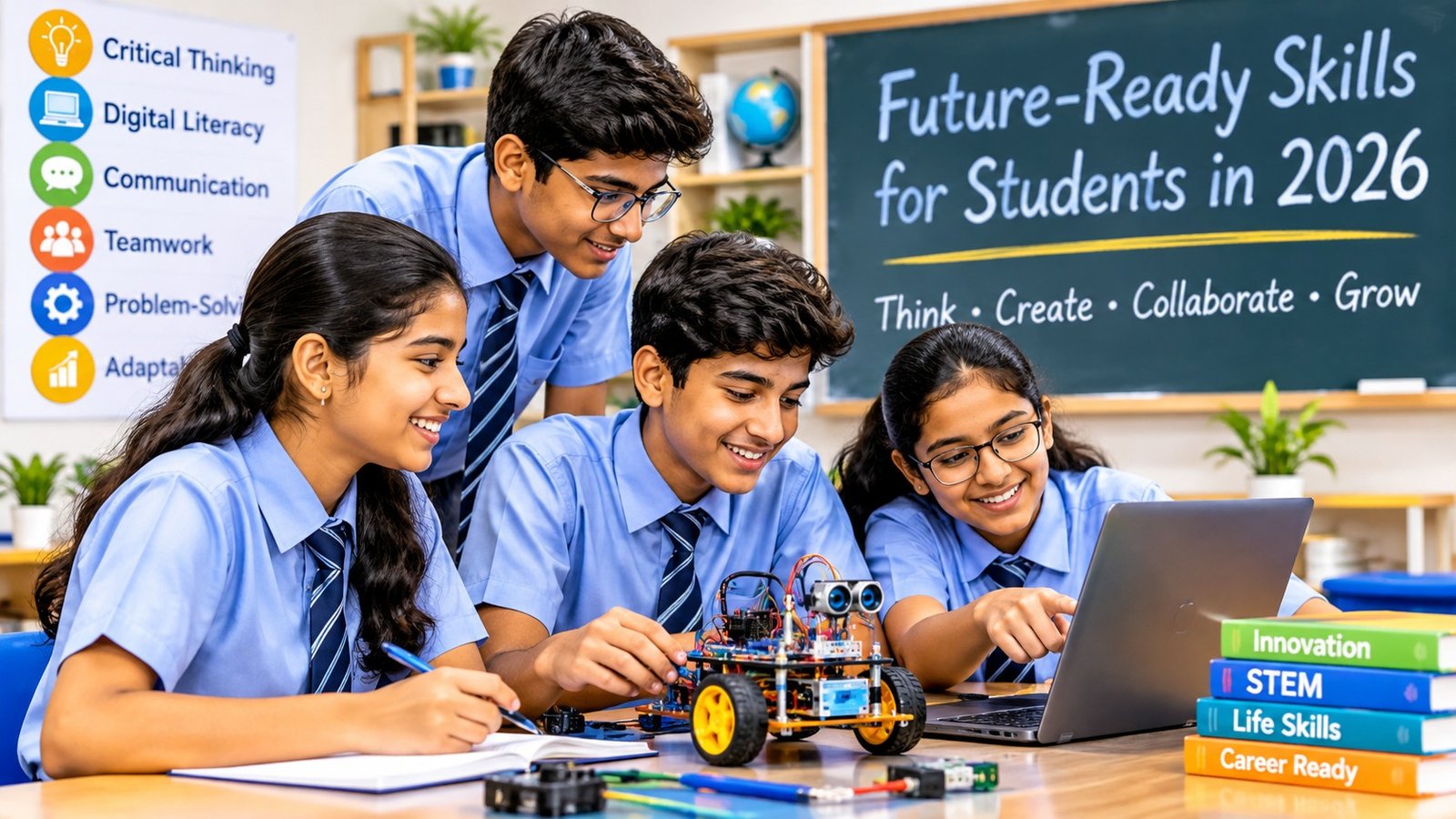
Academic knowledge is important, but students also need practical skills to succeed in a changing world. Explore the essential digital, communication, financial, creative and problem-solving skills that can prepare young learners for future careers.
# Future-Ready Skills for Students in 2026: What Schools Don't Always Teach
Getting good marks has always been an important goal for students. But is scoring well in examinations enough to prepare someone for the future?
The world of work is changing rapidly. Artificial intelligence, automation, digital platforms and new business models are changing how people study, communicate and earn a living. Employers increasingly value people who can solve problems, work with others, adapt to change and use technology effectively.
This does not mean academic education is becoming less important. Instead, students need to combine strong subject knowledge with practical abilities.
In 2026, the conversation around education in India is increasingly focused on future-ready skills, skill-based learning and the transition from school to work. The CBSE National Summit on Facilitating School-to-Work Transition, held in October 2026, highlighted technology, digital safety, creativity, innovation and career guidance as important priorities.
So, what should students start learning today to prepare for tomorrow?
1. AI Literacy: Understanding Artificial Intelligence
Artificial intelligence is no longer limited to technology companies. Students are already encountering AI through search tools, educational applications, writing assistants and digital platforms.
However, knowing how to open an AI tool is not the same as understanding artificial intelligence.
Students should learn:
- What artificial intelligence is and how it works at a basic level.
- How to use AI tools responsibly for learning and research.
- Why AI-generated answers can contain incorrect information.
- How to protect personal information when using AI applications.
- Why human judgement and original thinking remain important.
For example, a student can use an AI tool to understand a difficult science concept, but should still refer to textbooks, verify the explanation and solve questions independently.
AI literacy should encourage smarter learning, not replace independent thinking.
2. Digital Literacy and Cybersecurity
Almost every profession now involves some form of digital technology. From online banking to workplace communication, students will need to understand how to use digital platforms safely.
Digital literacy goes beyond operating a smartphone or computer.
Students should understand:
- Password security and two-factor authentication.
- Online privacy and personal data protection.
- Identifying suspicious links and fraudulent messages.
- Responsible social media behaviour.
- Recognising misleading information and online scams.
- Using digital tools for research and collaboration.
Cybersecurity awareness is particularly important because even a simple mistake, such as clicking an unknown link or sharing an OTP, can create serious problems.
Schools and parents can introduce these lessons through practical examples rather than only theoretical explanations.
3. Communication Skills: More Than Speaking English
Good communication is one of the most useful skills in education, employment and everyday life.
Students often focus on grammar, vocabulary and spoken English, but communication includes much more.
It involves expressing ideas clearly, listening carefully, asking relevant questions and understanding different viewpoints.
Students can develop communication skills by:
- Participating in classroom discussions.
- Practising public speaking.
- Writing emails and formal messages.
- Taking part in group presentations.
- Learning to listen without interrupting.
- Explaining complicated ideas in simple language.
A student who can confidently explain an idea, present a project or communicate with a team has an advantage in many academic and professional situations.
4. Critical Thinking and Problem-Solving
The internet provides access to enormous amounts of information. But students must learn how to decide which information is useful, accurate and relevant.
Critical thinking helps learners examine a situation instead of accepting every statement immediately.
For example, when a student reads a news report or receives an online message, they should consider its source, supporting evidence and possible bias.
Problem-solving skills can be developed through:
- Science experiments.
- Mathematics challenges.
- Real-life case studies.
- Group projects.
- Research assignments.
- Puzzles and logical reasoning activities.
The objective is to help students understand how to approach unfamiliar situations instead of depending entirely on memorised answers.
5. Financial Literacy: Understanding Money Early
Financial literacy is a life skill that students can benefit from long before they begin earning.
Many young people learn advanced mathematics but may have limited experience managing everyday money.
Students should gradually understand:
- The difference between needs and wants.
- Saving and budgeting.
- Bank accounts and digital payments.
- Interest and basic borrowing concepts.
- Responsible spending.
- Online payment safety.
Parents can introduce financial literacy through simple activities. For example, give children a small monthly budget and encourage them to plan how to spend or save it.
Older students can learn about bank statements, digital payment security, taxes and the basics of investing through age-appropriate educational resources.
Understanding money early can help young adults make more informed financial decisions later.
6. Creativity and Innovation
Future opportunities will not only depend on how much information students remember. Their ability to develop new ideas and find different solutions will also matter.
Creativity is useful in fields such as design, engineering, business, marketing, science, technology and education.
Students can develop creativity through:
- Building simple models.
- Participating in art and design activities.
- Creating presentations and videos.
- Developing small business ideas.
- Participating in science exhibitions.
- Experimenting with different solutions to a problem.
Schools should provide opportunities for students to create, test, improve and present their ideas.
A failed experiment can also become a valuable learning experience when students understand what went wrong and how to improve it.
7. Teamwork and Collaboration
Most professional environments require people to work with others.
Students who learn to collaborate early can become better at sharing responsibilities, listening to different opinions and completing common goals.
Teamwork involves more than dividing a project into separate tasks.
Students need to learn how to:
- Respect different opinions.
- Complete assigned responsibilities.
- Give constructive feedback.
- Resolve disagreements respectfully.
- Support team members.
- Take responsibility for mistakes.
Group assignments, sports, school clubs and community activities can provide useful opportunities to practise these skills.
8. Adaptability and Learning How to Learn
Technology, industries and job requirements change over time. A skill that is valuable today may need updating in the future.
This makes adaptability an important part of career readiness.
Students should become comfortable with learning new concepts, exploring unfamiliar tools and adjusting their approach when circumstances change.
One useful habit is to develop independent learning skills.
For example, if a student wants to learn graphic design, they can begin with basic tutorials, practise using beginner-friendly software and gradually build a small portfolio.
The ability to learn continuously can help students respond to changing opportunities throughout their lives.
9. Leadership and Decision-Making
Leadership is not limited to becoming a school captain or managing a large team.
It can begin with small responsibilities, such as organising a classroom activity, coordinating a group assignment or helping a team complete a project.
Students should learn how to:
- Set realistic goals.
- Take responsibility for decisions.
- Organise tasks.
- Manage time.
- Listen to team members.
- Evaluate the results of their actions.
Leadership also means understanding that decisions have consequences.
Providing students with age-appropriate responsibilities can help them develop confidence and accountability.
10. Environmental Awareness and Sustainability Skills
Climate change, pollution, water conservation and renewable energy are increasingly important topics across industries and communities.
Students should understand how everyday choices affect the environment and how different sectors are working towards sustainable development.
They can begin by learning about:
- Waste segregation and recycling.
- Water conservation.
- Renewable energy.
- Sustainable consumption.
- Environmental protection.
- Green technology and sustainable careers.
Schools can encourage students to participate in gardening projects, recycling drives, energy-saving campaigns and environmental research activities.
These experiences connect classroom learning with real-world challenges.
Why Future-Ready Skills Are Becoming Important in India
India's education and employment landscape is evolving. There is growing attention on connecting school education, higher education, vocational training and employment.
The CBSE National Summit on Facilitating School-to-Work Transition in October 2026 discussed the importance of technology, digital safety, design, creativity, innovation and career guidance.
NITI Aayog's August 2026 report, *Reimagining Skilling for Viksit Bharat@2047*, also discusses the need to connect education and skill development with changing industry requirements, emerging technologies and employment opportunities.
The India Skills Report 2026, as reported by NDTV, highlighted growing demand for areas such as artificial intelligence, data analytics, cloud computing and cybersecurity, alongside communication, problem-solving and adaptability.
These developments indicate that students need a combination of academic understanding, digital knowledge and practical abilities.
How Students Can Start Building These Skills Today
Students do not need to wait until college to develop future-ready skills. They can begin with small, consistent activities.
Choose one practical skill every month: Learn basic spreadsheet skills, presentation design, coding fundamentals, public speaking or digital research.
Build small projects: Create a simple website, prepare a research presentation, develop a budget or design a school campaign.
Participate in competitions: Science exhibitions, debates, quizzes, robotics activities and entrepreneurship competitions provide opportunities to apply knowledge.
Explore free learning resources: Use trusted educational platforms and beginner-level courses to understand new subjects.
Create a learning portfolio: Keep examples of projects, certificates, presentations and practical work. This can help students track their progress.
Ask for feedback: Teachers, parents and mentors can help students identify strengths and areas that need improvement.
The important thing is to practise rather than simply collect certificates.
What Parents and Schools Should Do
Students cannot develop every skill through textbooks alone. Parents and schools have an important role in creating opportunities for practical learning.
Parents can encourage children to manage small responsibilities, participate in discussions, explore hobbies and learn basic money management.
Schools can introduce more project-based learning, vocational exposure, technology activities, communication exercises and career guidance.
Teachers can also connect academic subjects with real-world examples. For instance, a mathematics lesson can include budgeting, while a science project can explore renewable energy.
The aim should not be to put extra pressure on children by asking them to master every emerging skill. Instead, students should receive age-appropriate opportunities to explore different interests and discover what they enjoy.
Frequently Asked Questions
1. What are future-ready skills for students?
Future-ready skills are abilities that help students adapt to changing academic, technological and professional environments. They include communication, critical thinking, digital literacy, AI literacy, creativity, teamwork and problem-solving.
2. Which skills should students learn in 2026?
Students can benefit from learning AI literacy, cybersecurity awareness, financial literacy, communication, data awareness, critical thinking, adaptability and teamwork. The most useful combination depends on their age, interests and future goals.
3. Why are employability skills important for students?
Employability skills help individuals apply their knowledge in practical situations. They support communication, collaboration, decision-making and the ability to adapt to workplace expectations.
4. Can school students learn AI skills?
Yes. Students can begin with age-appropriate lessons about artificial intelligence, responsible AI use, basic computational thinking and digital ethics. They do not need advanced programming knowledge to understand the basics.
5. How can parents help children develop future skills?
Parents can encourage reading, communication, practical projects, responsible technology use, budgeting activities and independent problem-solving. Giving children opportunities to make age-appropriate decisions also helps.
6. Are academic marks still important for future careers?
Yes. Academic knowledge remains an important foundation for higher education and many professional pathways. However, combining academic performance with practical skills can help students become better prepared for changing opportunities.
Conclusion
The future of education is not only about what students know but also about how effectively they can use that knowledge.
Artificial intelligence, digital technology and changing employment patterns are creating new opportunities as well as new challenges. Students who develop communication, creativity, critical thinking, financial literacy and practical digital skills will be better prepared to explore these changes.
Parents, teachers and schools can support this journey by making learning more practical, interactive and connected to everyday life.
A future-ready student is not someone who knows everything today. It is someone who is willing to keep learning, adapting and improving tomorrow.
 Career Guidance
 Career Guidance
 Career Guidance