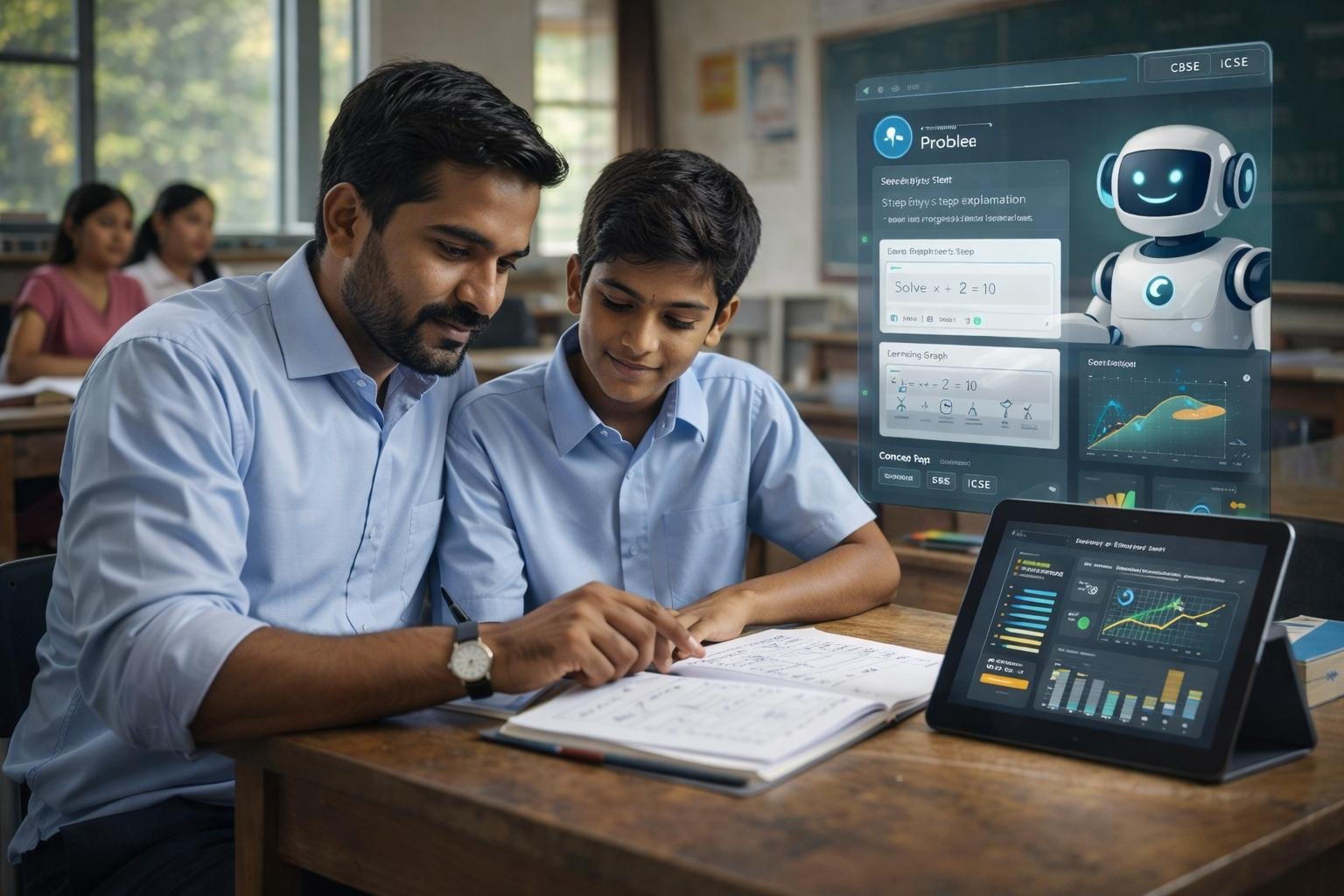
Discover how artificial intelligence is transforming education in India. Explore the benefits of AI for students and teachers, its challenges, responsible usage, and how technology is shaping the future of learning.
AI in Education: How Artificial Intelligence Is Changing the Way Students Learn
Artificial Intelligence is no longer limited to technology companies and software developers. It is gradually becoming a part of everyday education, changing how students study, how teachers prepare lessons, and how schools approach learning.
From AI-powered learning platforms to personalised study assistance, students now have access to tools that can explain difficult topics, generate practice questions, and help them understand concepts in different ways.
In India, this shift is becoming even more important. For the 2026–27 academic session, a dedicated Computational Thinking and Artificial Intelligence curriculum has been introduced for Classes 3 to 8 in collaboration with CBSE and NCERT.
Press Information Bureau+1
But what does this mean for students and teachers? Can AI actually improve education, and what should learners be careful about?
Let's take a closer look.
- Personalised Learning for Every Student
Every student learns differently. Some understand a topic quickly, while others need more examples, practice, or explanation.
AI-powered learning tools can help make studying more personalised by adjusting explanations and practice activities according to a learner's needs.
For example, a student struggling with mathematics can use an AI learning assistant to:
- Understand difficult formulas step by step.
- Get additional practice questions.
- Explore alternative explanations.
- Identify topics that need more revision.
This can make learning more flexible and give students additional support outside the classroom.
- Making Difficult Subjects Easier to Understand
Some academic concepts can be challenging when explained only through textbooks.
AI tools can help students understand complicated topics through simple explanations, examples, summaries, and interactive activities.
For instance, students can ask an AI tool to explain a scientific concept in simple language or provide examples of how a mathematical formula is used in everyday life.
However, students should always verify important information with textbooks, teachers, and reliable educational resources because AI-generated answers are not always accurate.
- How AI Can Help Teachers in the Classroom
AI is not just useful for students. It can also support teachers with everyday academic tasks.
Teachers can explore AI tools for:
- Preparing lesson plans.
- Creating worksheets and quizzes.
- Developing classroom activities.
- Generating examples for difficult topics.
- Preparing revision material.
- Organising teaching resources.
A November 2026 education update also highlighted the growing use of AI in Indian schools, including initiatives to help teachers develop AI-based digital learning materials.
EdexLive+1
These tools can save preparation time, allowing teachers to focus more on students and classroom interaction.
- Developing Future-Ready Skills
Understanding AI is becoming an important part of digital literacy.
Students don't necessarily need to become programmers, but learning how artificial intelligence works can help them prepare for a technology-driven world.
Some important skills students can develop include:
- Logical thinking
- Problem-solving
- Digital literacy
- Data understanding
- Creativity
- Critical thinking
- Responsible use of technology
The new Indian school curriculum also emphasises computational thinking, pattern recognition, algorithm design, and responsible AI use.
Press Information Bureau+1
- Can AI Replace Teachers?
This is one of the biggest questions surrounding the use of artificial intelligence in education.
AI can explain concepts, suggest learning activities, and provide instant responses, but teaching involves much more than sharing information.
A teacher understands students' difficulties, encourages participation, provides emotional support, and helps learners develop confidence.
For example, when a student repeatedly struggles with a particular topic, a teacher can recognise whether the problem is a lack of understanding, low confidence, or a different learning challenge.
AI may support this process, but it cannot fully replace the human connection between teachers and students.
The future of education is more likely to involve teachers using AI as a supporting tool rather than being replaced by it.
- The Challenges of Using AI in Education
Although AI offers several benefits, its use also comes with certain challenges.
Overdependence on AI: Students may start relying on AI to complete homework instead of developing their own understanding.
Incorrect information: AI tools can sometimes generate misleading or inaccurate answers.
Data privacy: Students should avoid sharing personal details, photographs, school information, or private academic records with AI platforms.
Digital access: Not every student has access to a smartphone, computer, or reliable internet connection.
Lack of guidance: Students and teachers need proper training to understand how to use AI responsibly.
These concerns are already being discussed in India's education sector, particularly around teacher training, digital infrastructure, and student data protection.
Moneycontrol+1
- How Students Can Use AI Responsibly
AI can be a useful study partner when students use it with the right approach.
Here are some simple ways to make better use of AI tools:
- Use AI to understand difficult concepts instead of copying answers.
- Ask for additional practice questions after completing a chapter.
- Use AI-generated summaries as revision support, not as a replacement for textbooks.
- Verify facts using trusted educational sources.
- Try solving problems independently before asking AI for help.
- Never share sensitive personal information with AI tools.
- Ask teachers for guidance whenever an AI-generated explanation seems confusing.
The goal should be to learn with AI, not depend entirely on it.
- What Does the Future of AI in Education Look Like?
AI is likely to become more closely connected with everyday teaching and learning.
In the coming years, students may experience more personalised study plans, interactive digital classrooms, AI-supported assessments, and learning resources that adapt to their progress.
Teachers may also get better tools for preparing lessons, identifying learning gaps, and creating engaging classroom activities.
However, technology alone cannot improve education. Good teaching, strong foundational knowledge, student participation, and equal access to learning resources will remain essential.
Final Thoughts
Artificial Intelligence is changing the education landscape, creating new possibilities for both students and teachers.
It can make learning more flexible, help explain difficult concepts, and support teachers with academic preparation. At the same time, students must learn to use these tools carefully and avoid becoming overly dependent on them.
AI should not replace curiosity, independent thinking, or the guidance of a good teacher.
The real opportunity lies in combining technology with effective teaching methods to make education more accessible, engaging, and meaningful.
 Online Learning
 Online Learning